The parachute
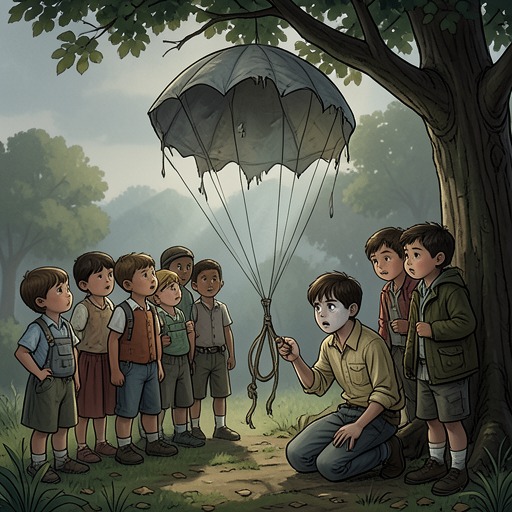
Lord of the FliesThe parachute is the wind-driven apparatus that makes a dead airman appear to be a living beast on the mountain. Its cords, fabric, and attached body first turn a distant shape into a terrifying sight for Ralph, Jack Merridew, and Roger; later, Simon recognizes how the movement works and frees the figure. The object gives the boys’ fear a material source, but its motion also shows how readily an ordinary mechanism can be mistaken for something monstrous when seen in darkness and under the pressure of dread.
Appearance and Physical Mechanism
At night, the parachute is not immediately recognizable as fabric or equipment. From a few yards away, the boys see a hump where they expect bare rock. When the wind rises, the figure lifts its head and presents what Ralph perceives as the ruin of a face. Their view is incomplete: darkness hides the lines and the shape of the body, while the wind supplies the movement that makes the shape seem alive.
The daylight account makes that mechanism visible. Simon sees a flicker of blue against brown clouds; as the blue parachute collapses, the corpulent figure bows forward. The gusts then lift it again, so that it seems to sit up and look down at him. Flies gather around the head and scatter briefly when the figure moves, before settling again as it falls forward. What had seemed like breath and intention is the repeated motion of fabric and body under changing wind.
The Night Sighting
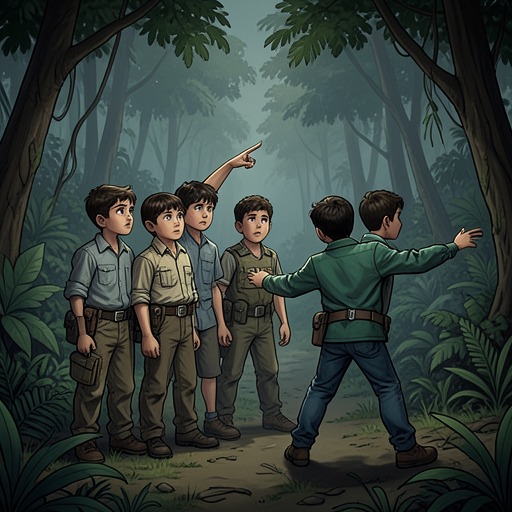
The object’s first decisive effect is to transform an indistinct shape into a threat. Jack reports seeing something bulge on the mountain and describes a noise before the thing bulged. Ralph doubts that any creature could do so, yet agrees to go and look. He, Jack Merridew, and Roger climb across the cinders and approach the summit together, stopping and crouching as they reach the top.
The dead fire leaves the summit dark. Ralph touches its cold, soft ashes and is jolted by the unexpected contact; nearby, Jack points out a hump in the place where a gap in the rock should be. Ralph cannot see clearly. After Jack and Roger move forward, the shape resolves for a moment into what seems to be a great ape sitting with its head between its knees. Then the wind roars through the forest, the figure lifts its head, and its ruined face appears to confront them. The boys flee down the slope, leaving three sticks behind. The parachute has not merely provided a silhouette: its intermittent movement has turned uncertainty into apparent confirmation of the beast.
Simon Identifies and Frees the Figure
Simon encounters the same figure in daylight, approaching across the mountain despite exhaustion and weakness in his legs. He sees the blue material collapse and the body bow, then crawls close enough to understand what he is looking at. The tangle of lines reveals the mechanics of the movement. He examines the nasal bone, teeth, and signs of corruption, and sees how layers of rubber and canvas hold the body together.
When another gust makes the figure lift and bow, Simon is sick. He then takes hold of the lines, frees them from the rocks, and releases the figure from the wind’s indignity. His discovery changes the meaning of the object: the apparently animate threat is a corpse moved by a parachute, not a creature living on the mountain. Simon understands that the beast is harmless, though the body remains horrible to see, and that the other boys need to learn what he has found. He starts down the mountain to tell them.
Removal and Narrative Significance
The parachute continues to move the airman’s body after Simon has freed it. In the storm, a great wind fills the fabric; the figure slides, rises, spins, and sways down through the wet air. It catches among the high trees, falls onward, and is carried across the lagoon, over the reef, and out to sea. The boys rush screaming into the darkness as it moves away. Its final passage is therefore not a deliberate act or a supernatural escape, but the same wind-driven motion that had made it seem alive on the summit.
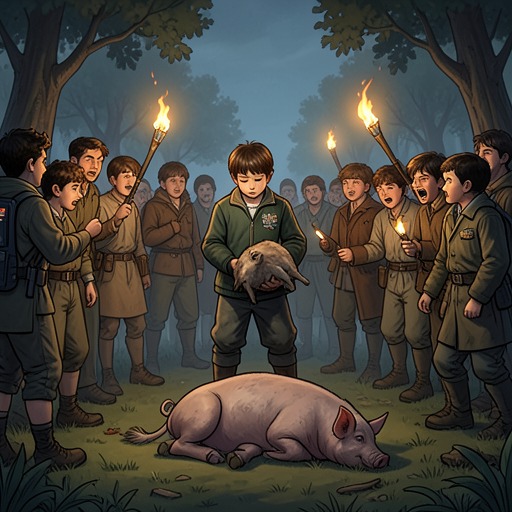
The distinction between the two bodies at the end of the scene matters. The parachute carries the dead airman out to sea; Simon’s body remains on the beach, where the boys’ violence has brought him down. The departing figure is the object that had been mistaken for the beast, while Simon is the boy who discovered its real nature and was then mistaken for that same threat. In this sequence, the parachute joins physical explanation to tragic irony: the fear it accidentally provokes helps shape the boys’ response to Simon, even as the actual mechanism of the supposed monster is exposed. Its cords and fabric make the error legible to Simon, but that knowledge comes too late to prevent the violence already set in motion.